
When an airplane enters a descent, its attitude changes from level flight to flight with a descent profile. [Figure] In a descent, weight no longer acts solely perpendicular to the flightpath. Since induced drag is decreased as lift is reduced in order to descend, excess thrust will provide higher airspeeds. The weight/gravity force is about the same. This causes an increase in total thrust and a power reduction is required to balance the forces if airspeed is to be maintained.
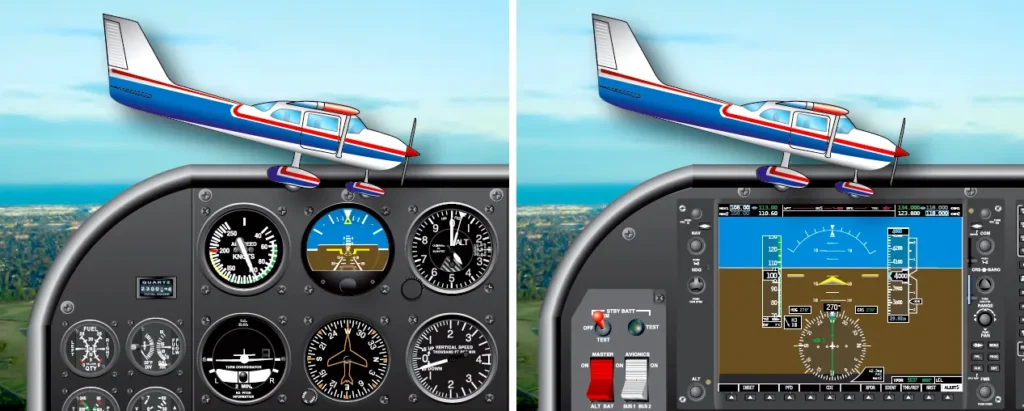
The pilot should know the engine power settings, natural horizon pitch attitudes, and flight instrument indications that produce the following types of descents:
- Partial power descent—the normal method of losing altitude is to descend with partial power. This is often termed cruise or en route descent. The airspeed and power setting recommended by the AFM/POH for prolonged descent should be used. The target descent rate should be 500 fpm. The desired airspeed, pitch attitude, and power combination should be preselected and kept constant.
- Descent at minimum safe airspeed—a nose-high, power-assisted descent condition principally used for clearing obstacles during a landing approach to a short runway. The airspeed used for this descent condition is recommended by the AFM/POH and is normally no greater than 1.3 VSO. Some characteristics of the minimum safe airspeed descent are a steeper-than-normal descent angle, and the excessive power that may be required to produce acceleration at low airspeed should “mushing” and/or an excessive rate of descent be allowed to develop.
- Emergency descent—some airplanes have a specific procedure for rapidly losing altitude. The AFM/POH specifies the procedure. In general, emergency descent procedures are high drag, high airspeed procedures requiring a specific airplane configuration (such as power to idle, propellers forward, landing gear extended, and flaps retracted), and a specific emergency descent airspeed. Emergency descent maneuvers often include turns.