
A loading schedule is used to document compliance with the certificated weight and balance limitations contained in the manufacturer’s AFM and weight and balance manual. The basic operating weight (BOW) and the operating index are entered into a loading schedule like the one in Figure 1, and the variables for a specific flight are entered as appropriate to determine the loaded weight and CG.
 |
| Figure 1. Loading schedule |
Use the data in this example:
Basic operating weight: 105,500 lb
Basic operating index (total moment/1,000): 98,837.0
MAC: 180.9 in
LEMAC: 860.5
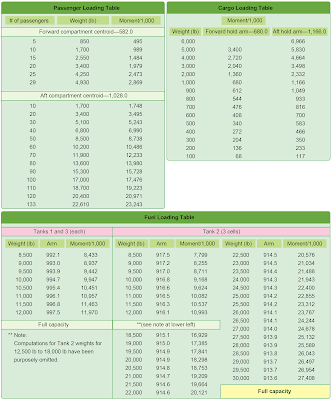 |
| Figure 2. Loading schedule for determining weight and CG |
The airplane is loaded in this way:
Passengers (nominal weight—170 pounds each)
Forward compartment: 18
Aft compartment: 95
Cargo
Forward hold: 1,500 lb
Aft hold: 2,500 lb
Fuel
Tanks 1 and 3: 10,500 lb each
Tank 2: 28,000 lb
 |
| Figure 3. Determining the location of the CG in inches aft of the datum |
Determine the distance from the CG to the LEMAC by subtracting the distance between the datum and LEMAC from the distance between the datum and the CG. [Figure 4]
 |
| Figure 4. Determining the distance from the CG to the LEMAC |
 |
| Figure 5. Determining the location of the CG in percent MAC |
- Establishing the Initial Weight of an Aircraft
- Determining the Empty Weight and Empty Weight CG (EWCG)
- Documenting Changes to an Aircraft’s Weight and Balance
- Determining CG Changes Caused by Modifying the Cargo (Part 1)
- Determining CG Changes Caused by Modifying the Cargo (Part 2)
- Determining CG Changes Caused by Modifying the Cargo (Part 3)