
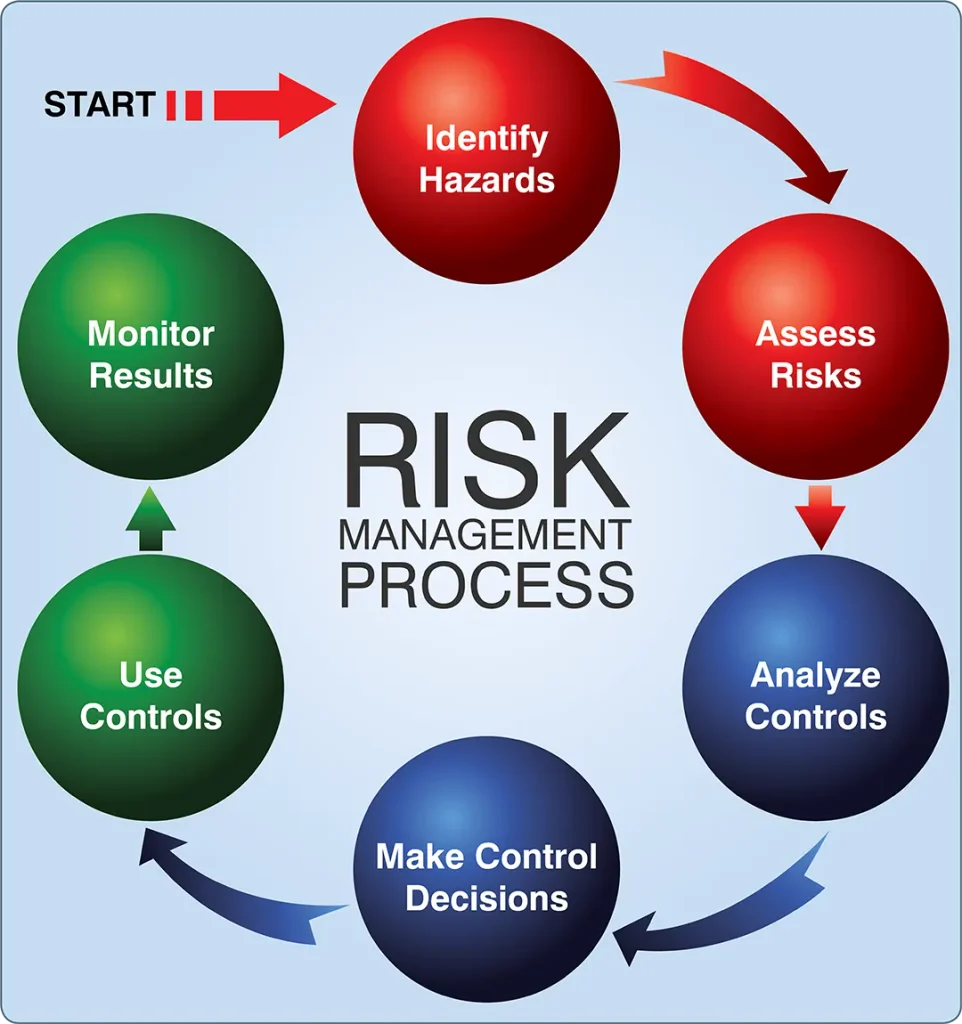
The goal of risk management is to proactively identify safety-related hazards and mitigate the associated risks. Risk management is an important component of ADM. When a pilot follows good decision-making practices, the inherent risk in a flight is reduced or even eliminated. The ability to make good decisions is based on experience, education, and both direct and indirect learning. The formal risk management decision-making process involves six steps as shown in Figure 1.
Consider automotive seat belt use. In just two decades, seat belt use has become standard practice, placing those who do not wear seat belts outside accepted safety practices, but this group may learn to wear a seat belt through either direct or indirect experience.
For example, a driver learns through direct experience about the value of wearing a seat belt when he or she is involved in a car accident resulting in personal injury. An indirect learning experience occurs when a loved one is injured during a car accident because he or she failed to wear a seat belt.
As you work through the ADM cycle, it is important to remember the four fundamental principles of risk management.
- Accept no unnecessary risk. Flying is not possible without risk, but unnecessary risk comes without a corresponding return. If you are flying a new airplane for the first time, you might determine that the risk of making that flight in low visibility conditions is unnecessary.
- Make risk decisions at the appropriate level. Risk decisions should be made by the person who can develop and implement risk controls. Remember that you are pilot-in-command, so never let anyone else—not ATC and not your passengers—make risk decisions for you.
- Accept risk when the benefits outweigh the costs. In any flying activity, it is necessary to accept some degree of risk. A day with good weather, for example, is a much better time to fly an unfamiliar airplane for the first time than a day with low IFR conditions.
- Integrate risk management into planning at all levels. Because risk is an unavoidable part of every flight, safety requires the use of appropriate and effective risk management not just in the preflight planning stage, but in all stages of the flight.
While poor decision-making in everyday life does not always lead to tragedy, the margin for error in aviation is small. Since ADM improves the management of the aeronautical environment, all pilots should become familiar with and apply ADM principles.
Quick Review: Risk Management
What is the primary goal of risk management in aviation?
What does it mean to make risk decisions at the appropriate level?
How do direct and indirect learning experiences differ in pilot education?
RELATED POSTS