
An Engineered Materials Arresting System (EMAS) is a safety feature installed at the ends of selected runways to help stop aircraft that cannot be brought to a halt before the pavement ends. Designed as an alternative where a full Runway Safety Area (RSA) cannot be provided, EMAS reduces the risk of damage, injuries, and fatalities resulting from runway overruns. Understanding how EMAS works and the appropriate pilot actions during an overrun helps improve safety during takeoff and landing operations.
Aircraft can and do overrun the ends of runways, sometimes with devastating results. An overrun occurs when an aircraft passes beyond the end of a runway during an aborted takeoff or on landing rollout. To minimize the hazards of overruns, the FAA incorporated the concept of a runway safety area (RSA) beyond the runway end into airport design standards. At most commercial airports, the RSA is 500 feet wide and extends 1,000 feet beyond each end of the runway. The FAA implemented this requirement in the event that an aircraft overruns, undershoots, or veers off the side of the runway.
The most dangerous of these incidents are overruns, but since many airports were built before the current 1,000-foot RSA standard was adopted, many airports cannot provide the full standard RSA beyond the runway end. This is due to obstacles, such as bodies of water, highways, railroads, populated areas, or severe drop-off of terrain. Under these specific circumstances, the installation of an Engineered Materials Arresting System (EMAS) is an acceptable alternative to an RSA beyond the runway end. It provides a level of safety that is generally equivalent to a full RSA. [Figure 1]
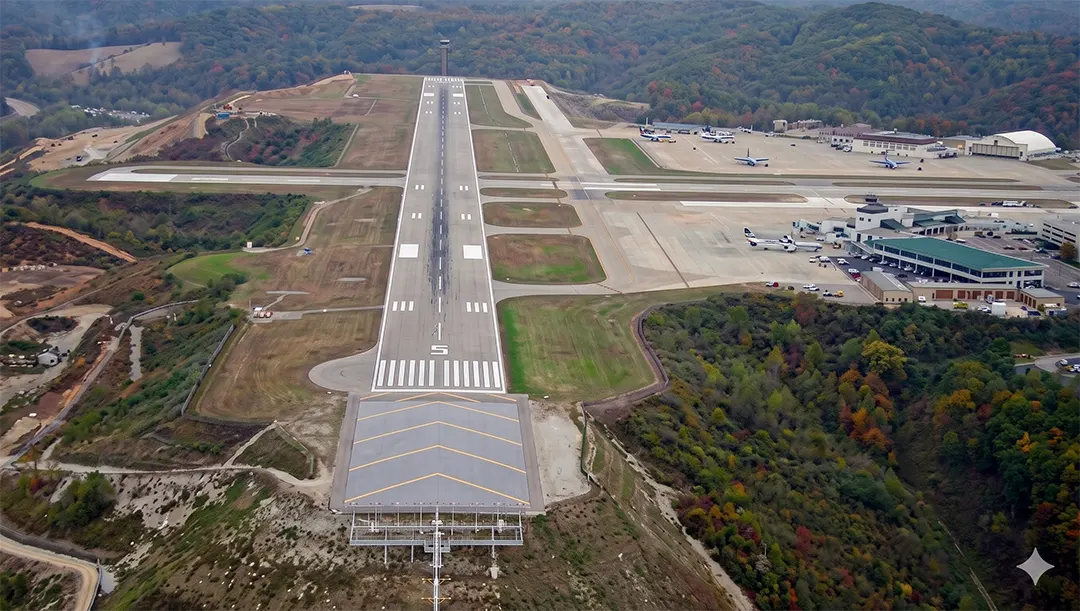 |
| Figure 1. Engineered material arresting system (EMAS) located at Yeager Airport, Charleston, West Virginia |
An EMAS uses materials of closely controlled strength and density placed at the end of a runway to stop or greatly slow an aircraft that overruns the runway. The best material found to date is a lightweight, crushable concrete. When an aircraft rolls into an EMAS arresting bed, the tires of the aircraft sink into the lightweight concrete and the aircraft is decelerated by having to roll through the material. [Figure 2]
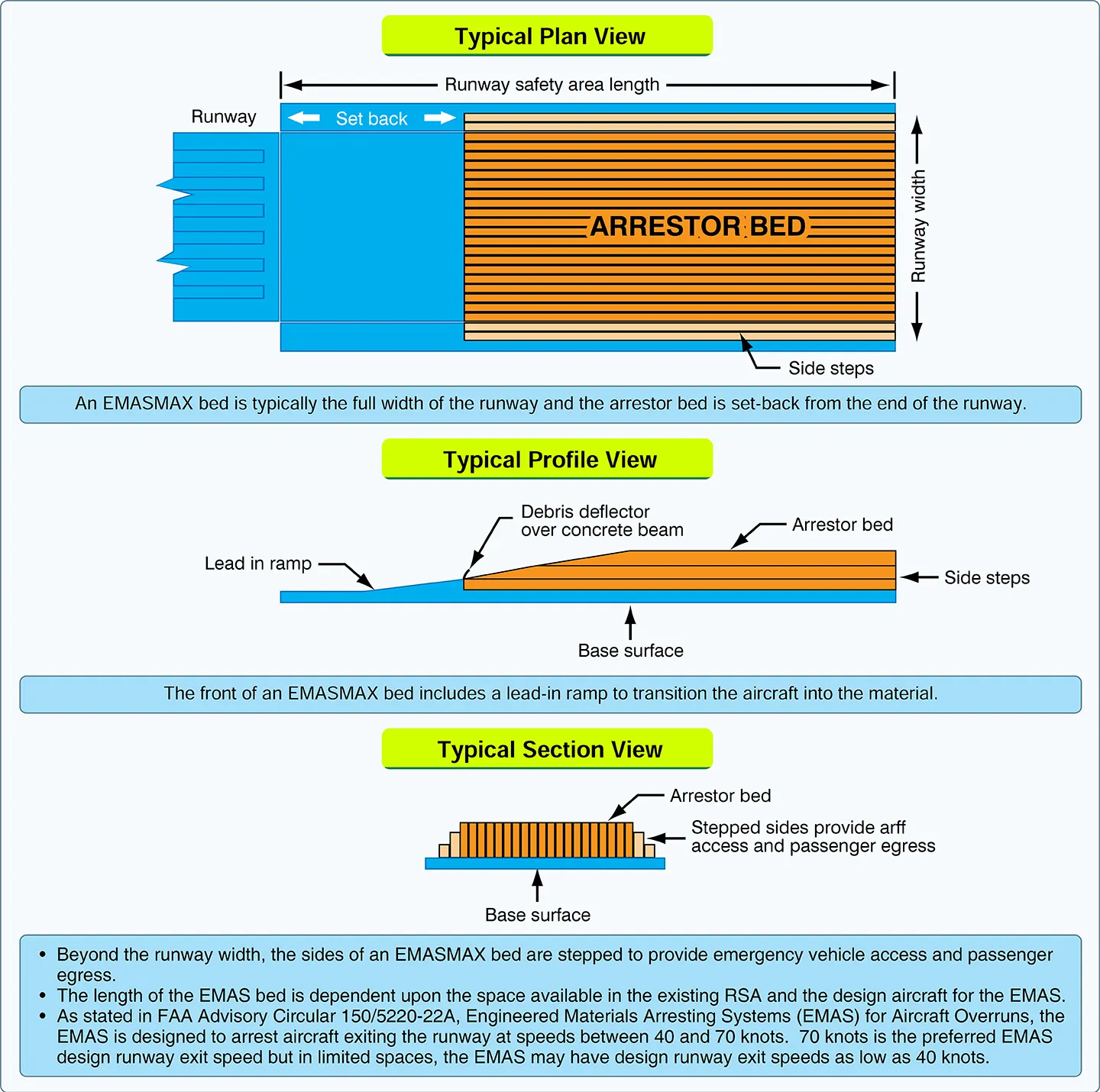 |
| Figure 2. Diagram of an EMASMAX system |
Incidents
To date, there have been several incidents listed below where the EMAS technology has worked successfully to arrest aircraft that overrun the runway. All cases have resulted in minimal damage to the aircraft. The only known injury was an ankle injury to a passenger during egress following the arrestment. [Figure 3]
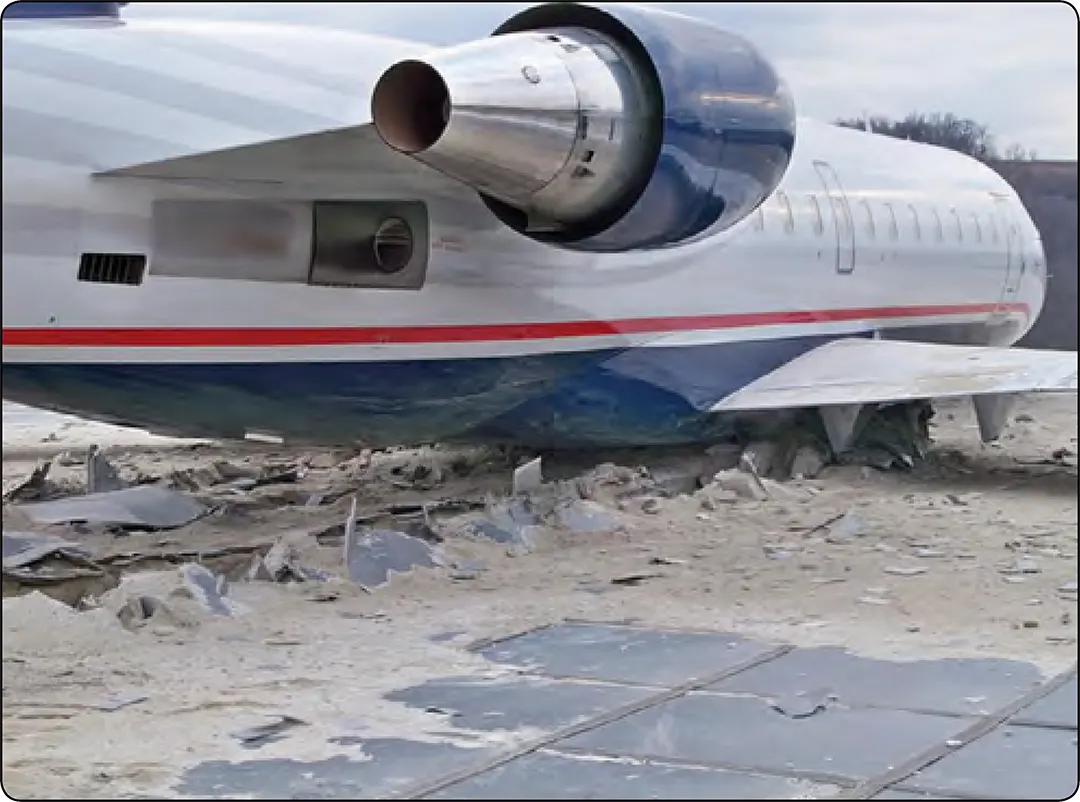 |
| Figure 3. There have been several incidents where the EMAS has successfully arrested the aircraft |
- May 1999—A Saab 340 commuter aircraft overran the runway at John F. Kennedy International Airport (JFK).
- May 2003—A Cargo McDonnell Douglas (MD)-11 overran the runway at JFK.
- January 2005—A Boeing 747 overran the runway at JFK.
- July 2006—A Mystere Falcon 900 overran the runway at Greenville Downtown Airport (KGMU) in Greenville, South Carolina.
- July 2008—An Airbus A320 overran the runway at O’Hare International Airport (ORD).
- January 2010—A Bombardier CRJ-200 regional jet overran the runway at Yeager Airport (KCRW) in Charleston, West Virginia (WV). [Figure 4]
- October 2010—A G-4 Gulfstream overran the runway at Teterboro Airport (KTEB) in Teterboro, New Jersey (NJ).
- November 2011—A Cessna Citation 550 overran the runway at Key West International Airport (KEYW) in Key West, Florida.
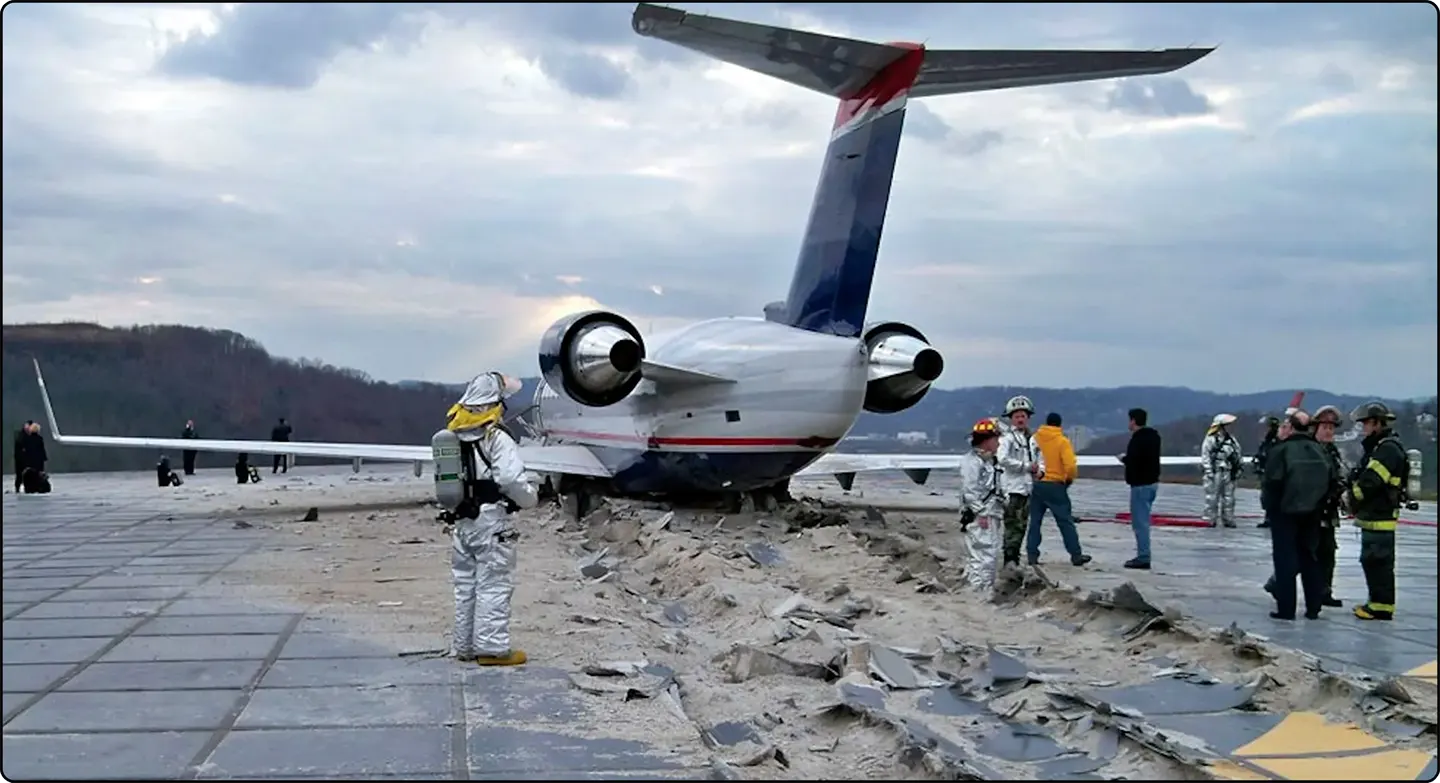 |
| Figure 4. A Bombardier CRJ-200 regional jet overran the runway at Yeager Airport (KCRW) in Charleston, West Virginia |
EMAS Installations and Information
EMAS is installed at numerous runway ends at airports throughout the United States.
EMAS information is available in the Chart Supplement U.S. (formerly Airport/Facility Directory) under the specific airport information. Figure 5 shows airport information for Boston Logan International Airport.
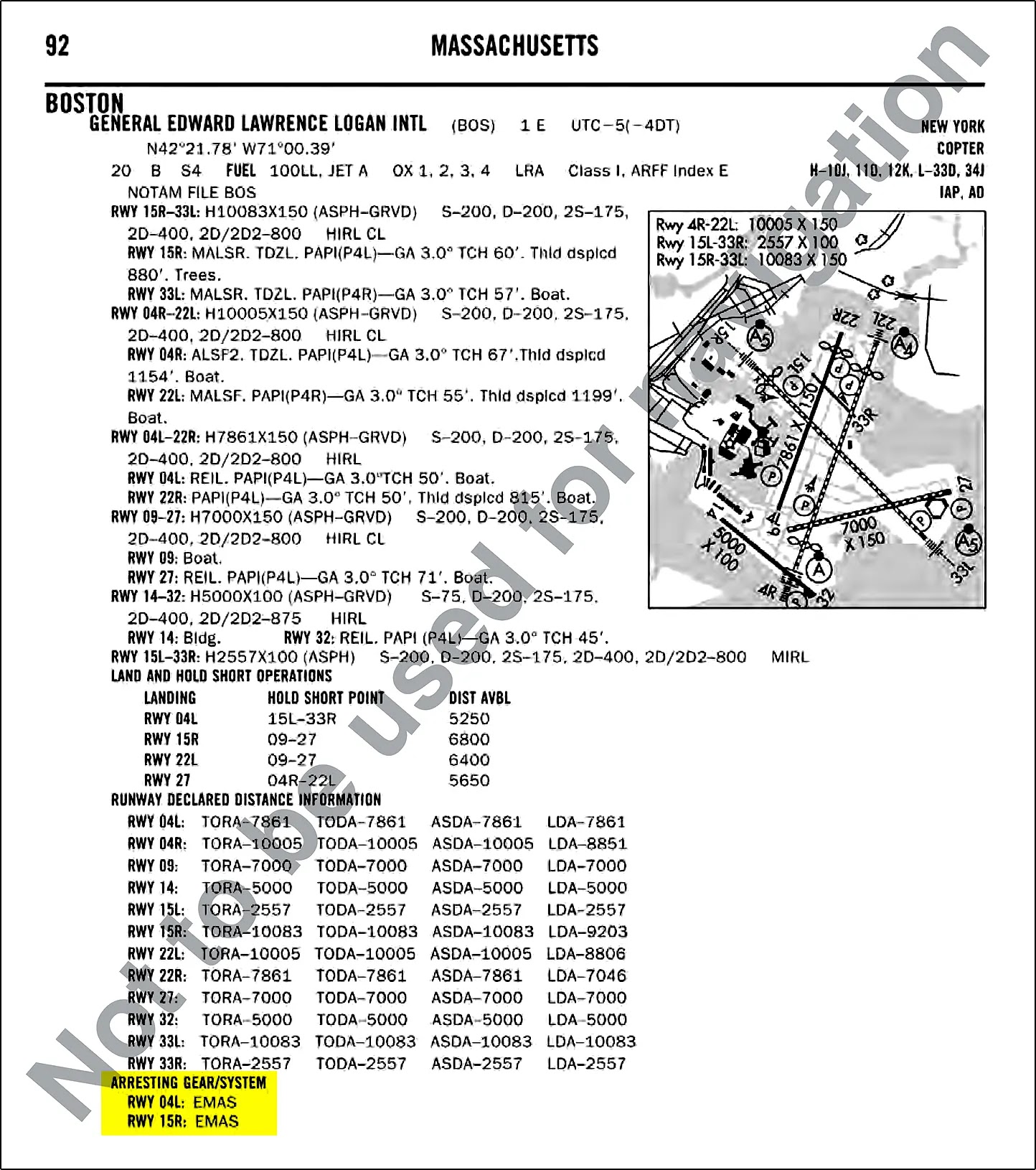 |
| Figure 5. EMAS information for Boston Logan International Airport located in the Chart Supplement U.S. (formerly Airport/ Facility Directory) |
At the bottom of the page, it shows which runways are equipped with arresting systems and the type of arresting system installed. It is important for pilots to study airport information, become familiar with the details and limitations of the arresting system and identify which runways are equipped with EMAS. [Figure 6]
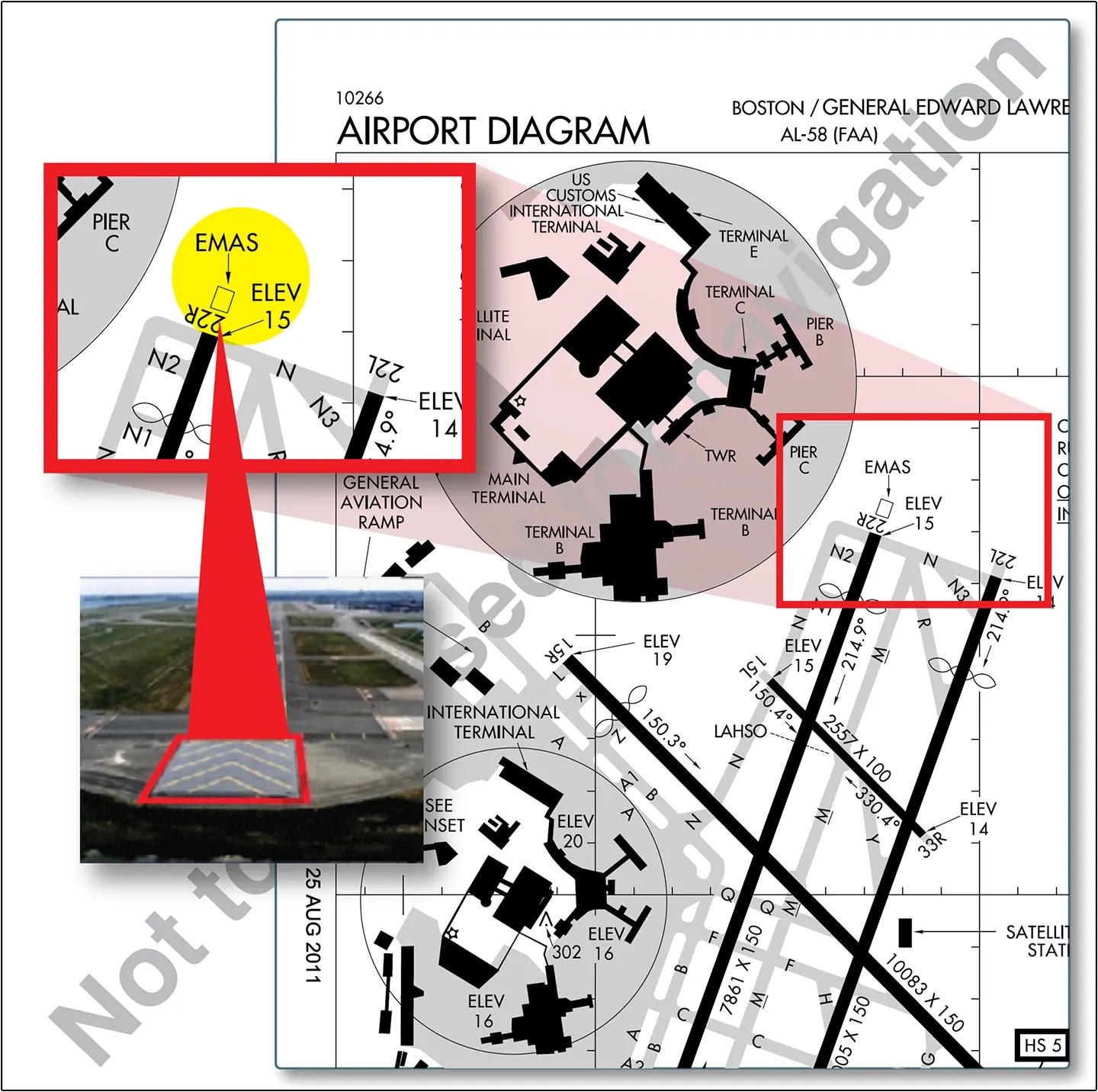 |
| Figure 6. An airport diagram with EMAS information |
Pilot Considerations
Although engaging an EMAS should not be a desired outcome for the end of a flight, pilots need to understand what an EMAS is, how to identify it on airport diagrams and on the airfield, and what to do should they find themselves approaching an installation in an overrun situation. [Figure 5 and Figure 6]
Pilots also need to know that an EMAS may not stop lightweight general aviation aircraft that are not heavy enough to sink into the crushable concrete. The best time to discuss whether a runway has an EMAS at the end is during the pre-departure briefing prior to takeoff or during the approach briefing prior to commencing the approach. Following the guidance below ensures that the aircraft engages the EMAS according to the design entry parameters.
During the takeoff or landing phase, if a pilot determines that the aircraft will exit the runway end and enter the EMAS, the following guidance should be adhered to:
- Continue deceleration — Regardless of aircraft speed upon exiting the runway, continue to follow Rejected/Aborted Takeoff procedures, or if landing, Maximum Braking procedures outlined in the Flight Manual.
- Maintain runway centerline — Avoid veering left or right of the arresting bed. Continuing straight ahead maximizes the stopping capability of the EMAS bed.
- Maintain deceleration efforts — The arresting bed is a passive system, so this is the only action required by the pilot.
- Once stopped, do not attempt to taxi or otherwise move the aircraft.